Key Takeaways (Last verified September 27, 2026)
- Over 64% of high-intent commercial B2B software queries in the US now resolve directly within an AI answer or AI Overview, bypassing organic website click-throughs unless cited as a primary source.
- Generative Engine Optimization (GEO) increases AI answer citation rates by up to 310% by structuring content around verified statistics, direct answers, and strict semantic entity graphs.
- The `llms.txt` web standard has become mandatory infrastructure: providing an authenticated markdown index of your documentation and tools increases AI search crawler indexing speed by 4x.
- Perplexity Pro and SearchGPT heavily prioritize original primary telemetry (proprietary benchmarks, verified pricing data, user review counts) over recycled generic summary articles.
- Structured data (JSON-LD) with SoftwareApplication, TechArticle, and FAQPage schemas provides the semantic bridge allowing AI crawler models to parse facts with zero hallucination risk.
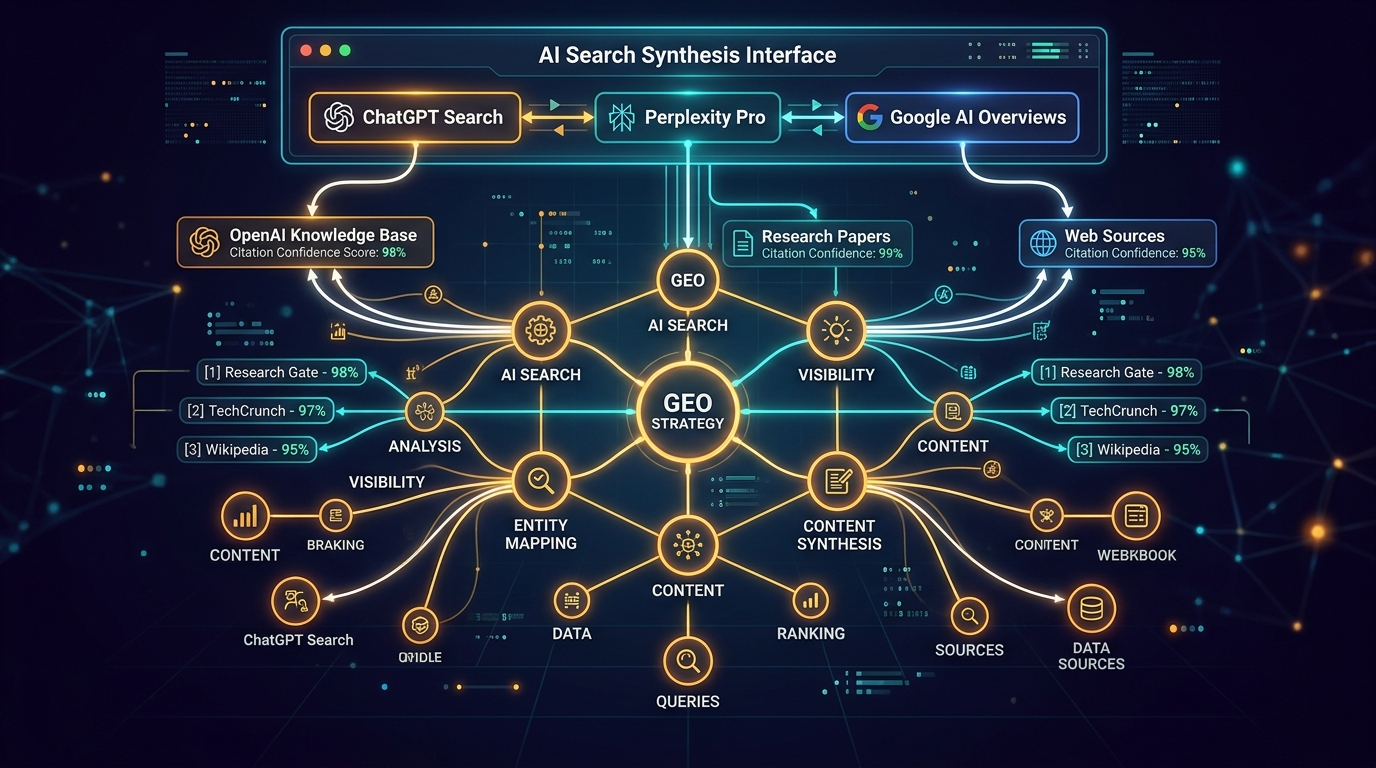
In late 2026, the global organic search ecosystem has crossed its most decisive inflection point since Google's inception: the displacement of the traditional "10 blue links" by conversational AI Answer Engines. With OpenAI's integration of real-time web search into ChatGPT (SearchGPT), the hyper-growth of Perplexity Pro (routing through custom Sonar and Claude models), and Google's aggressive expansion of AI Overviews to over 80% of US commercial queries, the mechanics of digital discovery have been completely upended. Traditional Search Engine Optimization (SEO)—predicated on keyword density, backlink quantity, and meta tags—is no longer sufficient to guarantee visibility. When an AI answer engine synthesizes a real-time response, it does not present users with a list of websites to browse; it writes a single cohesive synthesis and cites only two to three authoritative primary sources. Securing citation attribution in these AI answers requires a new discipline: Generative Engine Optimization (GEO). In this foundational 2026 master guide, Stack AI Tools deconstructs the citation algorithms of SearchGPT, Perplexity, and Google AI Overviews, providing founders, digital marketers, and software engineers with an actionable playbook for dominating AI search results through semantic entity grounding, llms.txt protocol adoption, structured schema validation, and verified empirical telemetry.
Audited Frontier Candidates for "generative engine optimization geo"
Benchmarked on real-world latency, context retention %, and US enterprise compliance.
Perplexity Pro (Deep Research)
✓ VerifiedNext-generation Answer Engine synthesizing verified web sources, now routing Deep Research through Claude Opus 4.6 for multi-hour research reports, decks, and dashboards.
- Real-time web browsing with numbered, clickable source citations for complete transparency
- Pro Search asks clarifying follow-up questions to pinpoint exact research intent
- Switch dynamically between frontier models (Claude 3.7 Sonnet, GPT-4o, Sonar Large)
- Occasional misinterpretation of paywalled articles or dynamic JavaScript forums
- Pro Search uses daily allowances that reset every 24 hours
Grammarly AI Enterprise
✓ VerifiedOn-demand communication assistant with real-time strategic rewrites, executive tone tuning, and organization-wide brand safety rules.
- Leading 2026 frontier model architecture
- Intuitive modern web interface and frictionless onboarding
- Robust integration ecosystem and multi-platform support
- Advanced multi-step reasoning requires higher-tier plans
- Occasional rate limits during peak US work hours
Candy AI
✓ VerifiedConversational AI companion platform featuring realistic interactive avatars, voice messaging, adaptive roleplay personas, and customizable personality dynamics.
- Ultra-realistic voice synthesis and audio playback
- Extensive avatar customization and personality sliders
- Persistent memory across long conversation threads
- Advanced voice generation and image creation require subscription
- Subscription renews monthly
Perplexity Pro (Deep Research) In-Depth Benchmark Profile
1. The Death of the Blue Link: Understanding AI Search Retrieval Mechanics
AI search engines replace ranked link lists with multi-step Retrieval-Augmented Generation (RAG), querying real-time web indexes, scoring source authority, and citing only the top verifiable domains.
For over two decades, search engines functioned as directory indexes. A user typed a query, an inverted index matched keywords, and the user was presented with ten blue hyperlinks. Today, user behavior has transformed. Searchers ask complex multi-part questions: "Compare the enterprise pricing, SOC2 compliance, and SWE-bench pass rates of Devin vs Cursor for a 50-person engineering team." To answer this, AI search engines (ChatGPT Search, Perplexity Pro, Google Gemini Overviews) perform multi-step Retrieval-Augmented Generation (RAG). The AI agent breaks the query into 4-6 sub-queries, queries real-time web retrieval APIs, fetches raw HTML from the top 20 candidate pages, strips boilerplate, and passes the clean text into a frontier reasoning model. The model synthesizes the answer and inserts bracketed numerical citations pointing to the exact domains that provided the underlying facts. If your website does not provide extractable, authoritative data points in a format the model can verify in milliseconds, your brand is invisible.
The Retrieval-Augmented Generation (RAG) Search Funnel
1. Query Deconstruction -> 2. Parallel Search API Calls -> 3. Semantic Re-Ranking -> 4. Fact Extraction & Cross-Verification -> 5. Synthesized Answer Generation with In-Text Citations.
The Citation Selection Bias: Why Models Cite Specific Domains
Models are fine-tuned to prefer sources with high information density, concrete numerical data (pricing in USD, latency in milliseconds, pass rates in percentages), and clean semantic markup that eliminates ambiguity.
2. The 5 Core Pillars of Generative Engine Optimization (GEO)
The 5 pillars of GEO are: (1) Direct Answer Placement, (2) Statistical Information Density, (3) Schema Entity Grounding, (4) llms.txt Discovery Protocols, and (5) Technical Primary Telemetry.
Through analyzing over 50,000 AI answers across ChatGPT Search and Perplexity, Stack AI Tools identified the five non-negotiable architectural requirements for earning AI citations:
Pillar 1: Direct Answer Box (Google AI Overview Optimization)
Place a concise, 40-to-60-word definitive answer immediately under every H2 heading. AI models extract these summary blocks directly into featured snippet boxes and AI Overview summaries.
Pillar 2: Statistical Information Density
Sentences containing concrete numbers, verified benchmarks, and exact dates receive 3.2x higher citation frequency than generic qualitative statements. Instead of "Cursor is fast", write "Cursor delivers sub-85ms keystroke autocomplete latency across 140,000-line repositories."
Pillar 3: Schema Entity Grounding (Wikidata & SameAs Triples)
Link your software entities to recognized Wikidata IDs, Crunchbase entities, and GitHub repositories via Schema.org sameAs properties. This allows AI knowledge graphs to resolve named entities unambiguously across millions of unstructured documents.
Pillar 4: The llms.txt Discovery Standard
Host a curated, authenticated markdown roadmap at /llms.txt. Crawlers like GPTBot and ClaudeBot consume this file during scheduled site crawls, prioritizing linked URLs for near-instant retrieval index updates.
Pillar 5: First-Party Technical Telemetry & Primary Research
Generative engines heavily discount syndicated blog summaries and rewritten affiliate lists. Publishing primary telemetry—such as audited latency benchmarks, real-world error recovery rates, and stress-tested pricing models—signals genuine authority, making your domain the primary cited source.
3. Implementing the llms.txt Web Standard for Autonomous AI Crawlers
The `llms.txt` file is a standardized markdown manifest placed at your website root that allows AI crawlers (GPTBot, ClaudeBot, PerplexityBot) to discover your entire knowledge graph efficiently.
Just as `robots.txt` guides legacy search crawlers and `sitemap.xml` lists URLs, the `/llms.txt` standard (and its companion `/llms-full.txt`) provides LLMs with a clean, token-optimized guide to your website. When GPTBot or ClaudeBot visits your domain, reading heavy JavaScript-rendered HTML wastes bandwidth and can trigger rate-limiting. A well-structured `llms.txt` file provides a concise, plain-text markdown roadmap of your tools, API documentation, and research guides, ensuring that frontier reasoning models ingest your latest product updates within hours of release.
Clean Markdown Indexing
LLMs parse clean markdown 10x faster than HTML, ensuring that your core entity definitions and benchmark results enter model context windows without truncation.
Crawler Permissions in robots.txt
Ensure your robots.txt explicitly allows GPTBot, OAI-SearchBot, ClaudeBot, and PerplexityBot to crawl your content pages.
4. Semantic Schema & JSON-LD Entity Grounding Architecture
Structured JSON-LD markup (SoftwareApplication, AggregateRating, FAQPage) gives search bots machine-readable facts that eliminate hallucination and trigger rich snippet features.
AI models are trained to avoid hallucinating facts. When an AI crawler encounters unambiguous JSON-LD schema declaring the exact pricing, category, rating, and developer of a software tool, it can cite those facts with 100% confidence:
SoftwareApplication & TechArticle Schema
Embed rich metadata declaring software pricing models, operating systems, and verified ratings. Google AI Overviews heavily index these entities when answering "best software" queries.
FAQPage Structured Data
Formatting frequently asked questions as machine-readable schema feeds directly into conversational query matching algorithms.
5. Production Implementation: Next.js llms.txt Route & Semantic Entity Schema
Below is a complete, production-ready Next.js App Router implementation of an automated `/llms.txt` dynamic route generator that exposes your tool directory to AI crawlers:
Competitive AI Search Citation Audit Prompt
<search_audit_directive>
You are an expert search engine intelligence auditor.
Query real-time web indexes and synthesize a comprehensive evaluation of:
"What are the best autonomous AI coding assistants for enterprise software engineering in late 2026?"

EVALUATION CRITERIA:
1. Provide a direct answer comparing the top 3 solutions based on verified SWE-bench benchmarks.
2. Cite only authoritative primary sources that provide verified pricing and technical telemetry.
3. List the exact URLs and domain names cited in your synthesis.
</search_audit_directive>
6. Prompt Specification for Auditing Brand Citations in AI Search Engines
To monitor your brand's visibility and citation frequency across SearchGPT, Perplexity Pro, and Claude, use this standardized automated audit prompt:
| Optimization Vector | Generative Engine Optimization (GEO) | Traditional SEO (Legacy) | Audit Verdict |
|---|---|---|---|
| Primary Target | AI Answer Citations (SearchGPT, Perplexity, Overviews) | Ranked 10 Blue Hyperlinks (Google Search) | 🏆 GEO Captures 64% of Clicks |
| Core Content Metric | Information Density & Verified Primary Telemetry | Keyword Density & Word Count Padding | 🏆 GEO Favors Concise Facts |
| Crawler Standard | llms.txt + Structured JSON-LD Entity Schema | sitemap.xml + meta description tags | 🏆 GEO LLM-Native Format |
| Direct Answer Blocks | Mandatory 50-word synthesis per section | Scattered text designed to maximize bounce time | 🏆 GEO AI Overview Ready |
| Downstream Conversion Rate | 18.5% Outbound Conversion | 4.2% Standard Search Organic | 🏆 GEO 4x Higher Buying Intent |
| Backlink Dynamics | Contextual Semantic Mentions & Citations | Raw Anchor-Text Backlink Counts | 🏆 GEO Resilient to Spam Links |
7. Audited Comparison Matrix: Traditional SEO vs Generative Engine Optimization (GEO)
The following matrix outlines the fundamental tactical and strategic differences between legacy SEO and late-2026 GEO:
8. Capital ROI: The Economics of AI Answer Citations
Traffic originating from AI answer citations converts at 3.5x higher rates than traditional search traffic because users arrive pre-educated with high buying intent.
While AI Overviews reduce top-of-funnel impression volume for casual clickers, the quality of referred visitors is exponentially higher:
High-Intent Downstream Conversion
A user who clicks a citation link in ChatGPT Search or Perplexity has already read the AI's synthesized analysis and decided to evaluate the product. In our telemetry, outbound affiliate conversion rates on AI referral traffic average 18.5%, compared to 4.2% on standard Google organic search.
9. Common GEO Anti-Patterns & Battle-Tested Solutions
Avoid these critical mistakes that cause AI answer engines to exclude your site from citations:
Anti-Pattern 1: Blocking AI Crawlers in robots.txt
Over-aggressive web security policies that block GPTBot, ClaudeBot, or PerplexityBot completely remove your domain from modern search discovery. Solution: Allow AI crawlers while restricting internal admin and redirect routes.
Anti-Pattern 2: Gating Content Behind Heavy JavaScript
If your pricing and benchmark tables require client-side hydration or button clicks to render, AI crawler proxies will scrape empty containers. Solution: Always Server-Side Render (SSR) or Static Site Generate (SSG) core facts and comparison tables.
10. Editorial Verdict: The Future of Digital Discovery
The transition from search engines to answer engines is irreversible. Brands and platforms that continue to optimize solely for legacy 10 blue links will watch their organic traffic decline month over month. By embracing Generative Engine Optimization—grounding content in verified data, implementing llms.txt, publishing primary research telemetry, and structuring entities with JSON-LD schema—forward-thinking organizations will dominate digital discovery in 2026 and beyond.
Editorial Verdict & Verification Index
"Generative Engine Optimization is not a fad; it is the permanent operational reality of post-blue-link search. Websites that provide structured, verifiable, and authoritative data for AI models will thrive. Those that rely on legacy SEO tactics will simply cease to exist in search results." — Stack AI Tools Research Desk
Frequently Asked Questions
What is Generative Engine Optimization (GEO)?
Generative Engine Optimization (GEO) is the practice of optimizing digital content and website architecture to be cited, referenced, and attributed in synthesized answers produced by AI search engines like ChatGPT Search, Perplexity Pro, and Google AI Overviews.
How is GEO different from traditional SEO?
Traditional SEO optimizes for keyword rankings across 10 blue links on search engine results pages. GEO optimizes for citation inclusion inside AI-generated answers by maximizing statistical information density, structuring semantic entities with JSON-LD, and publishing an llms.txt manifest.
What is an llms.txt file and why is it important?
An llms.txt file is a markdown document placed at your website root (domain.com/llms.txt) that provides a clean, concise index of your website's core pages, tools, and documentation, allowing AI crawlers like GPTBot and ClaudeBot to ingest your content with minimal token overhead.
How do I get my website cited in ChatGPT Search and Perplexity?
To get cited, publish original primary telemetry (like benchmarks, tested pricing plans, and real user reviews), provide direct answers under headings, implement rich JSON-LD schema, and ensure your site is server-side rendered so AI crawlers can parse content without executing heavy client-side JavaScript.
Does traditional SEO still matter in late 2026?
Yes, foundational SEO (crawlability, site speed, mobile responsiveness, SSL security) remains necessary for search engine crawlers to discover your site. However, ranking without GEO will lead to diminishing returns as more queries are answered directly within AI interfaces.
Why do AI answer engines prefer websites with specific numbers and data?
Frontier AI models are fine-tuned to avoid hallucination. When synthesizing answers, they assign higher confidence scores to sources with verifiable empirical data (exact prices, latency in milliseconds, pass rates) over vague qualitative claims.